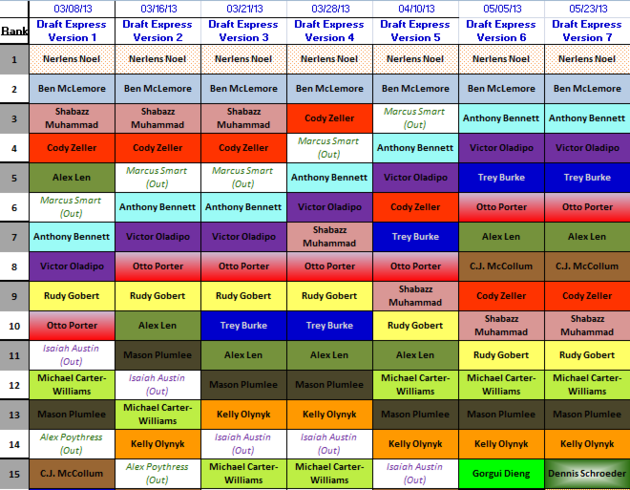
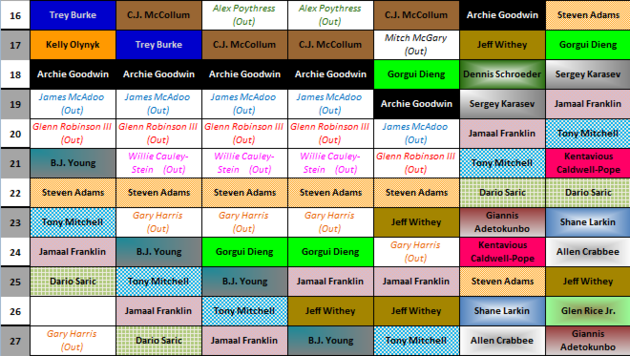
The explanation of his models(and the numbers from past drafts):
http://www.canishoopus.com/2013/5/13/43 ... 82-to-2012Conclusions:
Each player’s score is calculated using a unique model built from all other players in the dataset. This means that all retrodiction results are out of sample and thus an honest test of the model’s ability to accurately predict future prospects.
Looking through the results you will see that reliance on this model would have made some excellent picks in the past (Rondo, Lowry, Granger, Millsap, Stockton, Drexler, Zach Randolph, Artest, Ray Allen…) and avoided some clunkers (Austin Rivers, Randy Foye, Olowakandi, Joe Alexander)..., but it also would have advocated some embarrassing picks (Bo Kimble, Derrick Chievious, taking three players before Patrick Ewing…) and thrown a hissy over some early picks who ended up being excellent players (Deron Wiliams, LaMarcus Aldridge, Dikembe Mutombo...)
Some of these errors are impossible to easily explain and just need to be accepted as examples of just how difficult it is to predict who will succeed in the NBA. However looking through the data, I may have identified a few subjective heuristics to keep in the back of your mind.
1) 1. No fatties! Sweetney, Oliver Miller and Sean May are all near the top of the list of players who this model liked more than reality did. Being over-weight seems to work much better in college than it does in the pros. I haven’t tried addressing this in the model yet because weight’s effect is complicated. Sometimes heavy is good, but too much heavy is typically bad. It also doesn’t help that most of the real problem cases are guys who continued to expand after they were drafted. Guys like Kevin Love who go the other direction have a much better track-record.
2) 2. Beware the tween forward. This shouldn’t be a tough sell around these parts. Michael Beasley, Derrick Williams, Donyell Marshall, Glenn Robinson, and Antoine Walker were all pegged as stud prospects by this model. The level of NBA success varies across these cases, but all were a considerable disappointment based on this model’s projections as well as their actually draft slot. History says to avoid college 4s who depend on outside shooting (*cough* Anthony Bennett *cough*).
3) 3. I have not found enough data on shot locations and assisted rates to include it in the model, but my analysis of the dataset at Hoop-Math found that assisted jumpers are good, unassisted rim attempts are very good, and unassisted jumpers are very bad. Especially when gauging your opinion of my 2013 projections, I recommend seeing how your favorite player fits these criteria and subjectively factoring that in… I should also mention that ORBs are better than DRBs but those are not distinguished in the model so look for guys who collect more of the former.