ImageImageImageImageImage

Political Roundtable - Part VII

Moderators: nate33, montestewart, LyricalRico

bsilver
Rookie
Posts: 1,110
And1: 600
Joined: Aug 09, 2005
Location: New Haven, CT

Re: Political Roundtable - Part VII 

Post#1441 » by bsilver » Thu Oct 8, 2015 8:04 pm

nate33 wrote:
bsilver wrote:There's plenty of factual information available on de-institutionalization. Why would anyone rely on Coulter for this information? Of course she would blame liberals, but I don't see evidence of this unless you assume psychiatrists are liberal and that was the cause of their recommendations. It started in the 50s and 60s for several reasons:
There was lots of criticism of conditions of mental hospitals. (Ken Kesey's 1962 book, One Flew Over the Cuckoo's Nest is an example)
The hospitals were very expensive to maintain.
With the advent of drugs like thorazine, there was optimism that drugs would be the answer to the problem rather than long term institutionalization.
The movement started for community based solutions rather than large scale institutionalization.
Psychiatrists sold politicians a bill of goods that the hospitals were not as necessary anymore, and politicians were happy to go along. (There were lots of commissions and hearing in the 60s). Money was a big factor, but they were all most likely sincere in their beliefs that there was better alternatives.

Why can't institutionalizaton start again? It's prohibited by Supreme Court decisions, 1975 O'Connor vs Donaldson, and 1979 Addington vs Texas. The decisions basically say that non-violent mentally ill people can't be held against their will.

I didn't rely on Coulter for anything. I even pointed out that Coulter was likely to only be telling half the story on who was to blame for the decline in institutionalization.

I can understand that advances in drugs may have reduced the need for institutionalization, but that should have taken place in Europe as well. Is the difference in European institutionalization versus American institutionalization today due solely to those Supreme Court decisions? I would think that with something so ill-defined as mental illness, there would be bureaucratic and semantic ways to redefine those court decisions so that they weren't so constraining.

Europe went through de-institutionalization in a similar manner to the US. The reasons were basically the same. All the information you'd ever want to know on the subject is in the report reference by Ann C. She did cherry pick her numbers, not including countries with lower rates.
http://ec.europa.eu/health/ph_projects/2000/promotion/fp_promotion_2000_frep_08_en.pdf
Unfortunately it's 166 pages long.
The rights of the mentally ill are laid in UN Health Organization documents and European Union Human rights documents. These rights are not the law of the land for each European country. They have their own laws, which tend to be more flexible than proscribed by the US Court decisions. The European laws are generally written to preserve the rights of the patient.

I would agree there needs to be a better way to handle mental cases. European countries have shown that there can be involuntary institutionalization and still preserve rights. I know from the experiences of a friend with a mentally ill son, that the current US system does not work. It takes a major effort to show someone is a threat, and by that time it could be too late. Quick action is frequently needed to avoid disaster.

Maybe the US system could be changed, but I don't know if there's enough wriggle room in the Supreme Court decisions. Because of the decisions, it would probably require a big national effort to change the current system. It's hard to see that happening.
There are three kinds of lies: lies, damned lies, and statistics — quote popularized by Mark Twain.
User avatar
TheSecretWeapon
RealGM
Posts: 17,122
And1: 877
Joined: May 29, 2001
Location: Milliways
Contact:
       

Re: Political Roundtable - Part VII 

Post#1442 » by TheSecretWeapon » Thu Oct 8, 2015 10:40 pm

nate33 wrote:
TheSecretWeapon wrote:Don't have time to read Coulter's piece at the moment. I wonder if she addresses the policy of mass incarceration that started right around the same time, and the data indicating that many people (I think the percentage is over half) imprisoned for criminal acts suffer from mental illness. I also wonder if she addresses the research that seems to have found a link between lead and violent crime.

I should have omitted that last paragraph from Coulter's quote because it has made this a liberal versus conservative argument and I didn't intend it to be. I'm more interested in the mental illness versus violent criminal argument. I think Coulter might agree with you. Mass incarceration became (arguably) necessary because of the decline of institutionalization.

Yeah, I'm not interested in making it partisan. The "get tough on crime" policies were supported by both parties. My general feeling is that ascribing something like the rise and fall of violent crime rates to any single factor is going to be wrong. So, while I think Coulter is wrong in a lot of the supporting details, her fundamental theory that mass shootings may be a symptom of a poor mental health system is at least partly right.

I saw some interesting research summarized a few days ago that analyzed the "copycat" factor in mass shootings. Gladwell wrote about the phenomena in one of his books, except he was writing suicide clusters.
"A lot of what we call talent is the desire to practice."
-- Malcolm Gladwell

Check out my blog about the Wizards, movies, writing, music, TV, sports, and whatever else comes to mind.
User avatar
Induveca
Head Coach
Posts: 7,379
And1: 724
Joined: Dec 02, 2004
   

Re: Political Roundtable - Part VII 

Post#1443 » by Induveca » Fri Oct 9, 2015 3:08 am

How does the media play into the copycat scenario? The media would have you believe with their 24/7 4-5 day coverage they are honoring the "victims".

In reality they are mere pawns in democrat vs republican gun lobby which has zero chance of chance in most of our lifetimes.
popper
Veteran
Posts: 2,875
And1: 414
Joined: Jun 19, 2010

Re: Political Roundtable - Part VII 

Post#1444 » by popper » Fri Oct 9, 2015 3:23 pm

This is an interesting time-lapse of a San Francisco trend. They say trends start in CA and move east. Watch your step.

http://blog.sfgate.com/stew/2015/10/05/mapping-s-f-s-human-feces-on-the-streets/
User avatar
TheSecretWeapon
RealGM
Posts: 17,122
And1: 877
Joined: May 29, 2001
Location: Milliways
Contact:
       

Re: Political Roundtable - Part VII 

Post#1445 » by TheSecretWeapon » Fri Oct 9, 2015 4:18 pm

Induveca wrote:How does the media play into the copycat scenario? The media would have you believe with their 24/7 4-5 day coverage they are honoring the "victims".

In reality they are mere pawns in democrat vs republican gun lobby which has zero chance of chance in most of our lifetimes.

The media is a big part of the copycat stuff because it's a big source of information for new shooters. Researchers found that many shooters study what previous shooters did. There are shooters who used the Columbine duo as "inspiration" who weren't alive when Columbine happened. The new shooters looked stuff up on the internet.
"A lot of what we call talent is the desire to practice."
-- Malcolm Gladwell

Check out my blog about the Wizards, movies, writing, music, TV, sports, and whatever else comes to mind.
montestewart
Forum Mod - Wizards
Forum Mod - Wizards
Posts: 14,834
And1: 7,965
Joined: Feb 25, 2009

Re: Political Roundtable - Part VII 

Post#1446 » by montestewart » Fri Oct 9, 2015 6:47 pm

popper wrote:This is an interesting time-lapse of a San Francisco trend. They say trends start in CA and move east. Watch your step.

http://blog.sfgate.com/stew/2015/10/05/mapping-s-f-s-human-feces-on-the-streets/

For far too long, our white male dominated patriarchal society has relegated human feces to the shameful margins of otherness, the back alleys, vacant lots, and other overlooked nether worlds of existence. Things are changing, feces is out and loud. It's here, it stinks, get used to it. ( I expect an SC 1st Amendment case on the issue anytime now.)

PS: My nose tells me that s**t reached DC a long time ago. I hate it when my wife tells me "Cleanup in parking space one."
User avatar
nate33
Forum Mod - Wizards
Forum Mod - Wizards
Posts: 70,792
And1: 23,313
Joined: Oct 28, 2002

Re: Political Roundtable - Part VII 

Post#1447 » by nate33 » Sat Oct 10, 2015 2:00 pm

I came across some interesting data. The U.S. is pretty lousy relative to other developed countries in homicide rate, but they actually fare very well when looking at overall crime.

Image

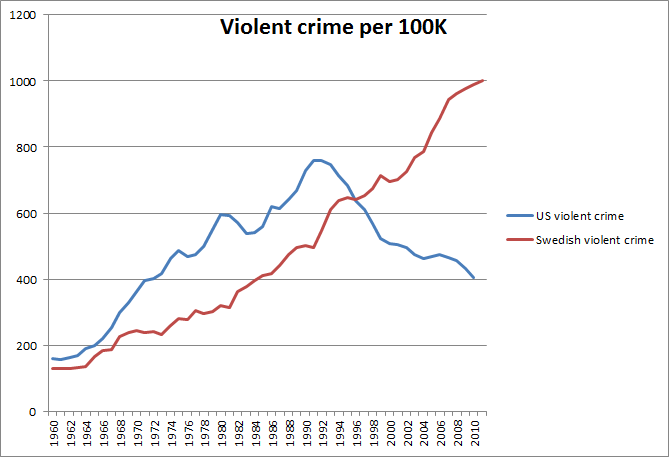
Crime in the U.S. continues to trend down, while Europe's crime does not. Here's a graph of U.S. versus Sweden:

Image

And versus England:

Image

So what is different about U.S. anti-crime policy than Europe? I think there are 3 major factors.

  • Guns. Widespread ownership and availability of guns in the U.S. deters lots of crime. This results in much lower incidents of property theft, rape and and assault. However, when one wants to commit a successful violent crime, the only way to be sure you succeed is to make sure you have the necessary firepower. As a result, a greater percentage of our violent crime is gun related homicide, even if there is less violence overall.
  • Incarceration. The U.S. puts lots of criminals behind bars for a long long time. One can argue that this is unfair to the criminals, and perhaps this is so, but it nevertheless results in a drop in violent crime.
  • Immigration. Europe is importing lots of violent Muslims from the Arab world. A significant percentage of these people are hostile to Western culture and Western notions of justice. The end result is a lot of violence. In the U.S., we are importing primarily Latin American immigrants. This may lead to some economic problems because the immigrants tend to be poorly educated and unskilled, but at least Latin Americans are not hostile to Western culture.
bsilver
Rookie
Posts: 1,110
And1: 600
Joined: Aug 09, 2005
Location: New Haven, CT

Re: Political Roundtable - Part VII 

Post#1448 » by bsilver » Sat Oct 10, 2015 2:42 pm

montestewart wrote:
popper wrote:This is an interesting time-lapse of a San Francisco trend. They say trends start in CA and move east. Watch your step.

http://blog.sfgate.com/stew/2015/10/05/mapping-s-f-s-human-feces-on-the-streets/

For far too long, our white male dominated patriarchal society has relegated human feces to the shameful margins of otherness, the back alleys, vacant lots, and other overlooked nether worlds of existence. Things are changing, feces is out and loud. It's here, it stinks, get used to it. ( I expect an SC 1st Amendment case on the issue anytime now.)

PS: My nose tells me that s**t reached DC a long time ago. I hate it when my wife tells me "Cleanup in parking space one."

Press release: NY Times, 10/10/2015
In response to the s**t problems caused by the white male dominated patriarchal society, largely affecting the black community, a previously unknown radical group masquerading as a Washington Wizards discussion forum, has announced the formation of #s**tmatters. #s**tmatters has demanded that the 2016 presidential candidates address the issue asap or face the consequences. Responses are quickly arriving.
Bernie Sanders - "This is an economic class issue. I don't see it as racial." He was quickly pelted with s***t.
Hillary Clinton - Seeing that tacking toward the Sanders view may not be a good idea in this case, invited #s**tmatters to visit her campaign for policy discussions.
Martin O'Malley - Agreed with all #s*tmatters positions. #s**tmatters responded, "Who is Martin O'Malley".
Joe Biden - Decided running for pres may not be a good idea after all.
Ben Carson - Provided a long response discussing guns, the holocaust, Jews, and slavery. It was not understood by anyone but his poll numbers quickly shot up.
Donald Trump - "Before deporting the 11 million illegal immigrants we'll have them clean up the s**t.
Marco Rubio - Said the problem needs to be turned over to the next generation. His speech was very articulate, for an Hispanic.
Carly Fiorina - Blamed Planned Parenthood for spreading fetal matter in the SF area. When challenged by the liberal media that the problem fecal matter, not fetal matter, Carly just sneered.
Bobby Jindal - Suggested he knew of a country where a lot of extra s**t could be sent and may not be noticed.
Chris Christie - Demanded that outbound SF traffic lanes be closed.
Lindsay Graham - Demanded US boots on the ground and a 100 billion dollar procurement for s**t resistant boots.
Mike Huckabee - Blamed islamo-fascists and was concerned over the existential threat to Israel. Stated that this was a definite sign of the coming apocalypse, and quickly started planning a pilgrimage to the holy land.
Ted Cruz - Blamed the president and demanded that the government be shutdown unless Obama personally cleans up the s**t with his bare hands.
Rand Paul - Gave a meandering speech on the need for a 10th amendment solution to the problem. Friends suggested maybe this presidential campaign wasn't such a good idea, and he should concentrate on the senate instead.
Jeb Bush - Addressed the issue in a speech in ebonics which he had learned from the black servants that raised him. Was immediately criticized by Trump, noting that he was brought up by 100% white servants.
John Kasich - Responded with compassion, but noted that if it was one thing that he knew from his 30 years of public service, it was that the unions were to blame for all the s**t in the world.
There are three kinds of lies: lies, damned lies, and statistics — quote popularized by Mark Twain.
popper
Veteran
Posts: 2,875
And1: 414
Joined: Jun 19, 2010

Re: Political Roundtable - Part VII 

Post#1449 » by popper » Sat Oct 10, 2015 4:16 pm

This rather long article establishes (for me at least) that the majority of peer-reviewed behavioral science studies mislead rather than inform. It's well worth your time.

Edit - It should be required reading for all college students.

http://www.weeklystandard.com/articles/making-it-all_1042807.html?page=1
User avatar
Induveca
Head Coach
Posts: 7,379
And1: 724
Joined: Dec 02, 2004
   

Re: Political Roundtable - Part VII 

Post#1450 » by Induveca » Sat Oct 10, 2015 9:57 pm

popper wrote:This rather long article establishes (for me at least) that the majority of peer-reviewed behavioral science studies mislead rather than inform. It's well worth your time.

Edit - It should be required reading for all college students.

http://www.weeklystandard.com/articles/making-it-all_1042807.html?page=1


Most of those "studies" are funded by an institution (NIH for example) to a research body after the funding institution has accepted the premise of the application to "potentially" yield beneficial results.

The entity granted the funds are under enormous pressure to skew any results towards the hypothesis contained in their original application for funding. If not? They are pretty much blackballed from additional funding.
User avatar
TheSecretWeapon
RealGM
Posts: 17,122
And1: 877
Joined: May 29, 2001
Location: Milliways
Contact:
       

Re: Political Roundtable - Part VII 

Post#1451 » by TheSecretWeapon » Sun Oct 11, 2015 1:42 am

nate33 wrote:I came across some interesting data. The U.S. is pretty lousy relative to other developed countries in homicide rate, but they actually fare very well when looking at overall crime.

Image

Crime in the U.S. continues to trend down, while Europe's crime does not. Here's a graph of U.S. versus Sweden:

Image

And versus England:

Image

So what is different about U.S. anti-crime policy than Europe? I think there are 3 major factors.

  • Guns. Widespread ownership and availability of guns in the U.S. deters lots of crime. This results in much lower incidents of property theft, rape and and assault. However, when one wants to commit a successful violent crime, the only way to be sure you succeed is to make sure you have the necessary firepower. As a result, a greater percentage of our violent crime is gun related homicide, even if there is less violence overall.
  • Incarceration. The U.S. puts lots of criminals behind bars for a long long time. One can argue that this is unfair to the criminals, and perhaps this is so, but it nevertheless results in a drop in violent crime.
  • Immigration. Europe is importing lots of violent Muslims from the Arab world. A significant percentage of these people are hostile to Western culture and Western notions of justice. The end result is a lot of violence. In the U.S., we are importing primarily Latin American immigrants. This may lead to some economic problems because the immigrants tend to be poorly educated and unskilled, but at least Latin Americans are not hostile to Western culture.

Those could be part of the issue. Another could be the persistently higher unemployment in Europe -- especially among young people. There's a bigger "safety net" over there, but idle time is still idle time. Just a theory. Interesting data.
"A lot of what we call talent is the desire to practice."
-- Malcolm Gladwell

Check out my blog about the Wizards, movies, writing, music, TV, sports, and whatever else comes to mind.
montestewart
Forum Mod - Wizards
Forum Mod - Wizards
Posts: 14,834
And1: 7,965
Joined: Feb 25, 2009

Re: Political Roundtable - Part VII 

Post#1452 » by montestewart » Sun Oct 11, 2015 3:36 am

nate33 wrote:I came across some interesting data. The U.S. is pretty lousy relative to other developed countries in homicide rate, but they actually fare very well when looking at overall crime.

Image

Crime in the U.S. continues to trend down, while Europe's crime does not. Here's a graph of U.S. versus Sweden:

Image

And versus England:

Image

So what is different about U.S. anti-crime policy than Europe? I think there are 3 major factors.

  • Guns. Widespread ownership and availability of guns in the U.S. deters lots of crime. This results in much lower incidents of property theft, rape and and assault. However, when one wants to commit a successful violent crime, the only way to be sure you succeed is to make sure you have the necessary firepower. As a result, a greater percentage of our violent crime is gun related homicide, even if there is less violence overall.
  • Incarceration. The U.S. puts lots of criminals behind bars for a long long time. One can argue that this is unfair to the criminals, and perhaps this is so, but it nevertheless results in a drop in violent crime.
  • Immigration. Europe is importing lots of violent Muslims from the Arab world. A significant percentage of these people are hostile to Western culture and Western notions of justice. The end result is a lot of violence. In the U.S., we are importing primarily Latin American immigrants. This may lead to some economic problems because the immigrants tend to be poorly educated and unskilled, but at least Latin Americans are not hostile to Western culture.

I was curious about the data from Sweden, so I went to the source, and as far as I can tell, the chart above was created by an individual, using data from U.S. and Swedish national agencies (websites links provided beneath the graph). The U.S. agency (DOJ) website had a tool for compiling data on violent crime, and that looks to correspond with the blue line in the U.S.-Swedish comparison. I was unable to find any comprehensive table or tool on the Swedish agency website to produce a comparable historical graph for violent crime. In other words, I have no idea how the person arrived at the figures, and glancing at various other websites, charts, and graphs regarding Swedish crime, I think the numbers are wrong, because most of the categories that I found seemed to show crime rates holding steady or even declining in some cases (like homicide). In searching for accurate statistics, I found numerous sites and references to a few things:

1) Many references to the problems with comparing crime statistics of one country to that of another country. In this case, I couldn't find a definition for "violent crime" on the DOJ website, and saw no comparable category on the Swedish webiste. Without the definition, I didn't know which individual categories to use in producing a total of "violent crime" in Sweden. A number of websites noted such things as the rate for reported kidnapping is higher in Canada than it is in Mexico, or that a U.N. sponsored survey found as many as 25% of males admitted to having participated in r***s (I'm not supposed to spell this out, right? I think I was warned once.) in some regions of Asia, though those same regions had very low rates of reported r*** in official statistics. Many variables (definitions of crimes, competence of police, confidence in judicial system, official fudging of numbers for political reasons, etc.) can influence crime statistics and make country comparisons difficult.

2) related to the above observation, I saw numerous references (including on Wikipedia and on State Department website) to changes in the way Sweden records crime that have created the appearance of a rise in crime, if the statistics are not properly assessed. For example, if three people jointly commit a homicide, apparently in Sweden that can now show up in statistics as three homicides. If a man r***s his wife every night, that is apparently now recorded as multiple, individual crimes In Sweden (whereas in the U.S., it apparently would be recorded as a single crime). This change in statistical reporting seems to have greatly contributed to the appearance of a rapid increase in reported r*** in recent years.

2a) I saw numerous observations of the correspondence between reported r*** rates and gender equality in a country. With greater sense of gender equality, perhaps there is a greater confidence that r*** allegations will be taken seriously.

2b) I saw numerous websites that seemed preoccupied with connecting the rise in r*** rates in Sweden to the influx of Muslims in the country. Maybe it really is depraved Muslim men rather than a change in tracking and reporting statistics, but I didn't really see those sites address the latter, merely showing the correspondence between the influx of Muslims men and the rising r*** rate. Maybe they were simply unaware of the changes in statistical tracking.

3) I don't know what Swedish gun laws are, but judging by Swedish movies and TV (a reliable source, I'm sure), it doesn't look like it's too hard to get a gun.

In DC, the MPD has been caught red handed fudging crime stats numerous times over the years, to name just one example of why I take my crime stats with a grain of salt. You and Nivek and PIF are stat gurus to me, but crime stats, that is some tough work.
User avatar
nate33
Forum Mod - Wizards
Forum Mod - Wizards
Posts: 70,792
And1: 23,313
Joined: Oct 28, 2002

Re: Political Roundtable - Part VII 

Post#1453 » by nate33 » Sun Oct 11, 2015 2:41 pm

montestewart wrote:I was curious about the data from Sweden, so I went to the source, and as far as I can tell, the chart above was created by an individual, using data from U.S. and Swedish national agencies (websites links provided beneath the graph). The U.S. agency (DOJ) website had a tool for compiling data on violent crime, and that looks to correspond with the blue line in the U.S.-Swedish comparison. I was unable to find any comprehensive table or tool on the Swedish agency website to produce a comparable historical graph for violent crime.

I agree that the definition of "violent crime" is likely to vary from country to country, so there's no use in trying to directly compare the aggregate numbers. However, that doesn't mean that the fact that the trend lines in violent crime show a massive deviation starting in 1990 isn't relevant. As long as there is consistency in the way they are gathering the numbers over time, we can infer that Sweden's numbers are continuing to climb relative to American numbers.

montestewart wrote:In other words, I have no idea how the person arrived at the figures, and glancing at various other websites, charts, and graphs regarding Swedish crime, I think the numbers are wrong, because most of the categories that I found seemed to show crime rates holding steady or even declining in some cases (like homicide). In searching for accurate statistics, I found numerous sites and references to a few things:

1) Many references to the problems with comparing crime statistics of one country to that of another country. In this case, I couldn't find a definition for "violent crime" on the DOJ website, and saw no comparable category on the Swedish webiste. Without the definition, I didn't know which individual categories to use in producing a total of "violent crime" in Sweden. A number of websites noted such things as the rate for reported kidnapping is higher in Canada than it is in Mexico, or that a U.N. sponsored survey found as many as 25% of males admitted to having participated in r***s (I'm not supposed to spell this out, right? I think I was warned once.) in some regions of Asia, though those same regions had very low rates of reported r*** in official statistics. Many variables (definitions of crimes, competence of police, confidence in judicial system, official fudging of numbers for political reasons, etc.) can influence crime statistics and make country comparisons difficult.

In light of these criticisms, I dug deeper for other data. I got this from A Comparative Criminology Tour of the World by Dr. Robert Winslow of San Diego State University.

INCIDENCE OF CRIME

The crime rate in Sweden is high compared to other industrialized countries. An analysis was done using INTERPOL data for Sweden. For purpose of comparison, data were drawn for the seven offenses used to compute the United States FBI's index of crime. Index offenses include murder, forcible rape, robbery, aggravated assault, burglary, larceny, and motor vehicle theft. The combined total of these offenses constitutes the Index used for trend calculation purposes. Sweden will be compared with Japan (country with a low crime rate) and USA (country with a high crime rate). According to the INTERPOL data, for murder, the rate in 2001 was 10.01 per 100,000 population for Sweden, 1.10 for Japan, and 5.61 for USA. For rape, the rate in 2001 was 23.39 for Sweden, compared with 1.78 for Japan and 31.77 for USA. For robbery, the rate in 2001 was 95.83 for Sweden, 4.08 for Japan, and 148.50 for USA. For aggravated assault, the rate in 2001 was 667.42 for Sweden, 23.78 for Japan, and 318.55 for USA. For burglary, the rate in 2001 was 1323.90 for Sweden, 233.60 for Japan, and 740.80 for USA. The rate of larceny for 2001 was 6988.81 for Sweden, 1401.26 for Japan, and 2484.64 for USA. The rate for motor vehicle theft in 2001 was 495.21 for Sweden, compared with 44.28 for Japan and 430.64 for USA. The rate for all index offenses combined was 9604.57 for Sweden, compared with 1709.88 for Japan and 4160.51 for USA. (Note that Japan data are for year 2000)

The data reported to INTERPOL make it appear that Sweden is perhaps the most crime ridden country in the world; however, these findings should be tempered by comparison with data reported to the United Nations. In the UN reports, murders are referred to as "intentional homicides." Aggravated assaults are referred to as "major assaults," and larcenies are referred to as "thefts." According to the United Nations Sixth Annual Survey on Crime, crime recorded in police statistics shows the crime rate for the combined total of all Index crimes in Sweden to be 6981.48, per 100,000 inhabitants in 1997. This compares with 1345.94 for Japan (country with a low crime rate) and 4930.06 for USA (country with high crime rate). For intentional homicides, the rate in 1997 was 1.77 for Sweden, 0.54 for Japan, and 6.80 for USA. For major assaults, the rate in 1997 was 37.93 for Sweden, compared with 20.91 for Japan, and 382.31 for USA. For rapes, the rate in 1997 was 14.71 for Sweden, 1.31 for Japan, and 35.93 for USA. For robberies, the rate in 1997 was 75.04 for Sweden, 2.23 for Japan, and 186.27 for USA. For automobile theft, the rate in 1997 was 890.75 for Sweden, 213.49 for Japan, and 505.99 for USA. The rate of burglaries for 1997 was 1664.41 for Sweden, 175.81 for Japan, and 919.35 for USA. The rate for thefts in 1997 was 4296.87 for Sweden, compared with 931.65 for Japan and 2893.41 for USA. It should be observed that the above data reveal that comparatively speaking, Sweden has a low crime rate in regard to murder and major assault, a medium crime rate in regard to rape and robbery, and an exceedingly high rate in regard to property crimes (burglary, larceny, and auto theft). The discrepancies between the data reported to the United Nations for 1997 and those reported to INTERPOL for 2001 are partly explained by Sweden’s peculiar method of reporting murder and assault. Murders reported to INTERPOL included both attempted and completed acts of murder, while "major assaults" included both simple and aggravated assaults. These statistical anomalies for Sweden actually obscure the actual low to moderate rate of the most serious crimes (murder, aggravated assault, rape, and robbery), and this point is important. Sweden actually prioritizes its treatment of crime in the criminal justice system giving priority to the serious crimes, and often diverting property crimes to out of court settlement by the police or prosecutors, often in the form of "day-fines."

http://www-rohan.sdsu.edu/faculty/rwinslow/europe/sweden.html

It would appear that in 1997 and 2001, Sweden had fairly high crime rates with respect to robbery and theft, but low violent crime rates. Rape was higher proportionally than murder and assault, but still relatively low.

However, when looking at the trends, violent crime seemed to be rising:
Between 1995 and 2001, according to INTERPOL data, the rate of murder increased from 9.00 to 10.01 per 100,000 population, an increase of 11.2%. The rate for rape increased from 19.00 to 23.39, an increase of 23.1%. The rate of robbery increased from 65.00 to 95.83, an increase of 47.4%. The rate for aggravated assault increased from 616.00 to 667.42, an increase of 8.3%. The rate for burglary decreased from 1615.00 to 1323.90, a decrease of 18.0%. The rate of larceny increased from 5861.39 to 6988.81, an increase of 19.2%. (Note: larceny data are from 1996 – not reported for 1995) The rate of motor vehicle theft decreased from 659.00 to 495.21, a decrease of 24.9%. The rate of total index offenses increased from 2983.00 to 2615.76, an increase of 8.6%.


This was during the time period when crime of all kinds was decreasing in the U.S. This data is fairly old, but it does correspond to the trends that I posted in my graphs earlier. Crime is increasing in Sweden while it is decreasing in the U.S. during the late 90's. If those trends continued in the 2000's, then my graphs look accurate with respect to trends.

montestewart wrote:2) related to the above observation, I saw numerous references (including on Wikipedia and on State Department website) to changes in the way Sweden records crime that have created the appearance of a rise in crime, if the statistics are not properly assessed. For example, if three people jointly commit a homicide, apparently in Sweden that can now show up in statistics as three homicides. If a man r***s his wife every night, that is apparently now recorded as multiple, individual crimes In Sweden (whereas in the U.S., it apparently would be recorded as a single crime). This change in statistical reporting seems to have greatly contributed to the appearance of a rapid increase in reported r*** in recent years.

That wikipedia page is interesting. It reads as if it was written by someone with the sole goal of refuting allegations that Sweden's crime rate is rising. Yet, if you look carefully at the graph, it tells a different story:
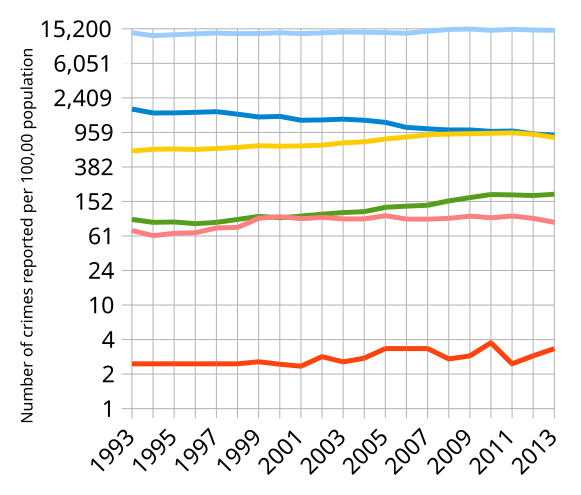
Image

The graph is visually deceptive because of the logarithmic scale. But if you look closely, you can see that assaults (yellow) are up from about 500 to about 900. Rapes (green) are up from about 90 to about 200. And robberies (pink) are up from about 70 to 90. Burglaries (blue) are down dramatically. Murders increased from 2.5 to 3.5, give or take.

A new system of crime reporting was implemented in 1990 which may indeed have caused a sudden increase in reported crime rates at the time, but there's no explanation as to how a one time change in 1990 would continue to cause a steady increase in reported violent crime for the next 20 years.

JWizmentality
RealGM
Posts: 14,101
And1: 5,122
Joined: Nov 21, 2004
Location: Cosmic Totality
   

Re: Political Roundtable - Part VII 

Post#1454 » by JWizmentality » Sun Oct 11, 2015 3:15 pm

http://www.cnn.com/2015/10/10/us/tamir-rice-shooting-reports/

Disgusting. I no longer have faith in the system.
User avatar
nate33
Forum Mod - Wizards
Forum Mod - Wizards
Posts: 70,792
And1: 23,313
Joined: Oct 28, 2002

Re: Political Roundtable - Part VII 

Post#1455 » by nate33 » Sun Oct 11, 2015 6:27 pm

JWizmentality wrote:http://www.cnn.com/2015/10/10/us/tamir-rice-shooting-reports/

Disgusting. I no longer have faith in the system.

I fail to see how this is unreasonable. The cops received reports of a "guy with a pistol" at the park. They pull up to the park, and a guy walks briskly toward the police car and reaches for a gun in his waistband. The cop shoots him.

We keep coming back to this. Somehow, the public has gotten into their head that cops should be superheroes - that they should be willing to risk their lives just to make sure they don't make a mistake. That's just not how the real world works. If cops hear a report that a guy is pointing pistols at people, and the guy is apparently crazy enough to reach for his pistol right in front of the cops, the cops will shoot him. If you don't want to get shot by a cop, don't walk toward them and reach for your fake gun.

I wonder if Officers Wenjian Liu and Rafael Ramos saw Ismaaiyl Brinsley approach them and reach for his waistband. Maybe they decided to give Mr. Brinsley the benefit of the doubt.
JWizmentality
RealGM
Posts: 14,101
And1: 5,122
Joined: Nov 21, 2004
Location: Cosmic Totality
   

Re: Political Roundtable - Part VII 

Post#1456 » by JWizmentality » Mon Oct 12, 2015 2:42 am

nate33 wrote:
JWizmentality wrote:http://www.cnn.com/2015/10/10/us/tamir-rice-shooting-reports/

Disgusting. I no longer have faith in the system.

I fail to see how this is unreasonable. The cops received reports of a "guy with a pistol" at the park. They pull up to the park, and a guy walks briskly toward the police car and reaches for a gun in his waistband. The cop shoots him.

We keep coming back to this. Somehow, the public has gotten into their head that cops should be superheroes - that they should be willing to risk their lives just to make sure they don't make a mistake. That's just not how the real world works. If cops hear a report that a guy is pointing pistols at people, and the guy is apparently crazy enough to reach for his pistol right in front of the cops, the cops will shoot him. If you don't want to get shot by a cop, don't walk toward them and reach for your fake gun.

I wonder if Officers Wenjian Liu and Rafael Ramos saw Ismaaiyl Brinsley approach them and reach for his waistband. Maybe they decided to give Mr. Brinsley the benefit of the doubt.


You believe what you want to believe. There's no way you can determine the kid reached for anything in that video. That's the account of the cop who was previously let go from another department because he was emotionally unstable mind you. Yes, in all of 2 seconds you believe the 12 year old kid reached for his gun and charged the cops. Apparently, that's what unarmed folks do now a days. We charge the police. We're demons I tell you. Just like John Crawford pointed his toy gun at police while on his phone, just like Walter Scott reached for the cop's tazer, just like Samuel Dubose was dragging the officer into his car. Shame we don't have any video of these things. We must take the cop at his word. Black people be acting a fool, running into bullets n sh*t. :roll:

And no, I don't expect cops to be superheroes. The job is hard enough. I do however expect them to be able to assess a situation. Not speed your car right up to a suspect and shoot. Here's a novel reenactment nate. Cop car speeds up to 12 year old kid, he reaches for his waist to and says "It's a to...*Bang* he's dead. Seems more plausible than your narrative of a kid with a death wish. He was a thug who wanted to challenge the police with his toy gun. Not a child who was scared sh*tless from two guys speeding up to him with guns drawn. This is your justifiable use of force?
JWizmentality
RealGM
Posts: 14,101
And1: 5,122
Joined: Nov 21, 2004
Location: Cosmic Totality
   

Re: Political Roundtable - Part VII 

Post#1457 » by JWizmentality » Mon Oct 12, 2015 3:01 am

nate33 wrote:
JWizmentality wrote:http://www.cnn.com/2015/10/10/us/tamir-rice-shooting-reports/

Disgusting. I no longer have faith in the system.

I fail to see how this is unreasonable. The cops received reports of a "guy with a pistol" at the park. They pull up to the park, and a guy walks briskly toward the police car and reaches for a gun in his waistband. The cop shoots him.

We keep coming back to this. Somehow, the public has gotten into their head that cops should be superheroes - that they should be willing to risk their lives just to make sure they don't make a mistake. That's just not how the real world works. If cops hear a report that a guy is pointing pistols at people, and the guy is apparently crazy enough to reach for his pistol right in front of the cops, the cops will shoot him. If you don't want to get shot by a cop, don't walk toward them and reach for your fake gun.

I wonder if Officers Wenjian Liu and Rafael Ramos saw Ismaaiyl Brinsley approach them and reach for his waistband. Maybe they decided to give Mr. Brinsley the benefit of the doubt.


Those cops were assassinated by a lunatic who just strolled up to their car. He knew what he wanted to do and unfortunately, nothing could have prevented that. Are you saying that any individual who comes within 3 feet of a police car must be shot on site? Please elaborate, because that's exactly what you're implying. How should have officer Ramos and Liu acted?
fishercob
RealGM
Posts: 13,922
And1: 1,571
Joined: Apr 25, 2002
Location: Tenleytown, DC

Re: Political Roundtable - Part VII 

Post#1458 » by fishercob » Mon Oct 12, 2015 2:20 pm

[youtube]https://www.youtube.com/watch?v=LORVfnFtcH0&feature=youtu.be[/youtube]
"Some people have a way with words....some people....not have way."
— Steve Martin
User avatar
nate33
Forum Mod - Wizards
Forum Mod - Wizards
Posts: 70,792
And1: 23,313
Joined: Oct 28, 2002

Re: Political Roundtable - Part VII 

Post#1459 » by nate33 » Mon Oct 12, 2015 2:24 pm

JWizmentality wrote:
nate33 wrote:
JWizmentality wrote:http://www.cnn.com/2015/10/10/us/tamir-rice-shooting-reports/

Disgusting. I no longer have faith in the system.

I fail to see how this is unreasonable. The cops received reports of a "guy with a pistol" at the park. They pull up to the park, and a guy walks briskly toward the police car and reaches for a gun in his waistband. The cop shoots him.

We keep coming back to this. Somehow, the public has gotten into their head that cops should be superheroes - that they should be willing to risk their lives just to make sure they don't make a mistake. That's just not how the real world works. If cops hear a report that a guy is pointing pistols at people, and the guy is apparently crazy enough to reach for his pistol right in front of the cops, the cops will shoot him. If you don't want to get shot by a cop, don't walk toward them and reach for your fake gun.

I wonder if Officers Wenjian Liu and Rafael Ramos saw Ismaaiyl Brinsley approach them and reach for his waistband. Maybe they decided to give Mr. Brinsley the benefit of the doubt.


Those cops were assassinated by a lunatic who just strolled up to their car. He knew what he wanted to do and unfortunately, nothing could have prevented that. Are you saying that any individual who comes within 3 feet of a police car must be shot on site? Please elaborate, because that's exactly what you're implying. How should have officer Ramos and Liu acted?

We don't know exactly how those cops were assassinated. Clearly, someone walked up to the car and shot them. What I wonder is if the cops saw him coming. Perhaps Brinsley made a move to reach for his gun but the police were slow to react. My point is that it's a dangerous place out there for cops. They need to be ready to respond to any threatening gesture.

Here is what the cops in Cleveland saw:
Image
Image

The cops were much closer and weren't looking at a grainy, time lapsed photo. They could see exactly what he was doing with his hands in real time at close range. Bear in mind that there were reports of a man brandishing a gun. They did not hear the information that it was probably an adolescent and that it was possibly a toy gun.

This is a horrible tragedy. But it is completely understandable from the cops' point of view.
JWizmentality
RealGM
Posts: 14,101
And1: 5,122
Joined: Nov 21, 2004
Location: Cosmic Totality
   

Re: Political Roundtable - Part VII 

Post#1460 » by JWizmentality » Mon Oct 12, 2015 4:02 pm

nate33 wrote:
JWizmentality wrote:
nate33 wrote:I fail to see how this is unreasonable. The cops received reports of a "guy with a pistol" at the park. They pull up to the park, and a guy walks briskly toward the police car and reaches for a gun in his waistband. The cop shoots him.

We keep coming back to this. Somehow, the public has gotten into their head that cops should be superheroes - that they should be willing to risk their lives just to make sure they don't make a mistake. That's just not how the real world works. If cops hear a report that a guy is pointing pistols at people, and the guy is apparently crazy enough to reach for his pistol right in front of the cops, the cops will shoot him. If you don't want to get shot by a cop, don't walk toward them and reach for your fake gun.

I wonder if Officers Wenjian Liu and Rafael Ramos saw Ismaaiyl Brinsley approach them and reach for his waistband. Maybe they decided to give Mr. Brinsley the benefit of the doubt.


Those cops were assassinated by a lunatic who just strolled up to their car. He knew what he wanted to do and unfortunately, nothing could have prevented that. Are you saying that any individual who comes within 3 feet of a police car must be shot on site? Please elaborate, because that's exactly what you're implying. How should have officer Ramos and Liu acted?

We don't know exactly how those cops were assassinated. Clearly, someone walked up to the car and shot them. What I wonder is if the cops saw him coming. Perhaps Brinsley made a move to reach for his gun but the police were slow to react. My point is that it's a dangerous place out there for cops. They need to be ready to respond to any threatening gesture.

Here is what the cops in Cleveland saw:
Image
Image

The cops were much closer and weren't looking at a grainy, time lapsed photo. They could see exactly what he was doing with his hands in real time at close range. Bear in mind that there were reports of a man brandishing a gun. They did not hear the information that it was probably an adolescent and that it was possibly a toy gun.

This is a horrible tragedy. But it is completely understandable from the cops' point of view.


Are we at the point where you just have to think you're in trouble to use lethal force? Is that where we are going? Is that how you justify a child, who you will only refer to as "the guy," being killed playing with a toy gun? Are cops being gunned down in the streets daily. Nope, turns out it's never been a safer time to be a cop.
https://www.washingtonpost.com/news/the-watch/wp/2015/09/10/once-again-there-is-no-war-on-cops-and-those-who-claim-otherwise-are-playing-a-dangerous-game/

So, why do cops feels the need to kill anything that moves? You want to talk about the cop's point of view? Let's talk about the report he filed. Suspect was told repeatedly to drop weapon. Lie. Tamir was shot within 2 seconds of the officer extricating the vehicle which hadn't even come to a complete stop. Suspect pointed the weapon at me. Lie. Even in your grainy images at best it appears he is attempting to lift his jacket before he is on the ground bleeding out. At no point was he threatened. But no, cops need to ready to respond to any "perceived" threat, and a 12 year old black boy playing with a toy gun in an open carry state is as threatening as they come. Lifting up his jacket was all it took. They gave a child all of 2 seconds to decide how to act with guns trained on him. Coincidence, it's the same amount of time they gave John Crawford, who was shopping. This in your mind in "reasonable?"

Return to Washington Wizards