Post#29 » by trex_8063 » Wed Feb 28, 2024 12:20 am
Induction vote: Bob Cousy
Been waiting forever to have this guy on the ballot. Far overdue for the guy who was literally THE face of the PG position (and probably the best to grace the position as well) until Oscar/West showed up.
Was a notable piece of SEVEN contender teams, winning six titles, and led some winning teams prior to that.
He stands extra tall in terms of both media-awarded and player/peer-awarded accolades, fwiw:
*There are only 16 players in NBA/ABA history with as many or more All-Star selections......and all of them were LONG since inducted.
**There are only 11 players in NBA/ABA history with as many or more All-NBA selections.......and all of them were LONG since inducted.
***He's one of only 5 NBA MVP's who have yet to be inducted......though among them, only he and Iverson actually played 29k+ minutes in his career.
People look to knock his offense, but he anchored or co-anchored not one, not two, but THREE #1 offenses in the early-mid 50s (plus another #2-rated offense).
He was not good enough [apparently] to be the best player on a title-winning team........though that hardly seems a disqualifier given I think that this is arguably true of literally EVERY CANDIDATE we have presently on the ballot, not to mention several [or all??] of the last handful of inducted players: Kyle Lowry wasn't either, nor was Bobby Jones or Rasheed Wallace; and most likely Lillard and George weren't/aren't either.
I'd like to take a moment to talk about the seeming poor offenses in the Russell-era, which is often a fixation of his critics (while they ignore the elite offenses that came prior).
I'd mentioned that the pace-mandate [from Red] necessitated a lot of [bad] shots early in the shotclock, which were frequently taken by the guy(s) handling the ball. This contributes to both poorish team offense, and [arguably] to Cousy's own shooting efficiency.
@ Owly:
It was mentioned that Red always wanted to push the pace, even pre-Russell. So why didn't it affect things in that pre-Russell time period?
Well, I'd done a correlation study, looking at relative pace vs rORTG year-by-year........and I found that there seems to be a "tipping point" or critical threshold: a pace threshold where if you're trying to push significantly past it [faster], it is to the detriment of your offense.
I noted that a very faint correlation begins to appear in years where the league-average pace is >107 (that is: where increasing rPace corresponded with worsening rORTG [or where slowing rPace corresponded with better rORTG]).
The correlation looks more reliable ["real"] in seasons where the league average pace was >115.
Which makes some sense conceptually: every possession cannot be a transition opportunity; so to maintain certain "extreme" paces, it requires taking whatever first shot presents itself (which---it goes without saying, I think---that many of those will be low quality).
And what's more, I found the OPPOSITE effect when dealing with really sluggish paces: in years were the league average pace was <92, increasing rPace was mildly correlated with INCREASING rORTG (or stated alternately: playing SLOWER than this already sluggish league-average resulted in WORSENING offense).
This too kinda makes some sense, as paces around 90 and lower almost necessitates a relative lack of transition, necessitates ALWAYS giving the defense ample time to set-up in the half-court, and likely represents relatively little offensive flow and off-ball movement (because if you WERE moving, good shots would [at least once in awhile] present themselves early in the shotclock: and then your pace wouldn't be lagging around 85-90).
So when did Boston's individual pace tip above that 115 threshold? As it turns out: '57, the year Russell arrived.
What year did the league average (which Boston was ALWAYS well-ahead of) top 115? Well, it hit 117 in '58, dropped back to 112 for one year in '59, then bounced to >120 in '60, where it remained for a few years.
The Celtics played at an estimated pace of 125 or higher for Cousy's last FIVE seasons straight (and was 124.8 the year before that). In terms of relative to league avg, the SLOWEST pace in those years was a +7.8 rPace (one of only two years that were <+10 rPace).
The mantra I remember from my youth was "work the ball around, find a good shot".
For the Celtics of this era it was "shoot the damn ball already! don't slow the game down!"
So yes, I contest that such extremes were hurting their offense. (EDIT: btw, I mentiond the THREE #1 offenses, plus a #2 offense......the ONLY pre-Russell/prime Cousy year in which the Celtics were NOT #1 or #2 offensively was in '56, when their pace had jumped to nearly that 115 threshold [at 114.5, which was +11.7 to the league avg]; they were still 3rd that year)
I've further commented that the pace listed on bbref [and thus the rORTG/rDRTG data] is all estimated, because certain statistics were not yet recorded......such as turnovers. Turnovers were estimated largely based upon how many shots a team was taking: it was basically assumed that if you're getting "X" number of shots off, than it must correspond with a proportionate amount of turnovers.
But what if----because you're shooting early in the clock---you have less opportunity to turn the ball over (as has been suggested for these Russell-era Celtic teams)? Why, that would mean the pace estimate on bbref is HIGHER than reality!.......and thus that the ORtg listed is LOWER than reality (and the DRtg HIGHER than reality). Having logged some Celtic games from the early 60s, I could buy this as valid, since it does not appear as frenetic [visually] as circa-135 pace would suggest.
Take '59 as an example: Celtics supposedly had a 128.7 pace (way the hell out in front of league avg [by +16.7!], with a -0.4 rORTG [5th of 8 teams]. Suppose that within that pace estimate bbref is OVER-estimating their turnovers by a rate of just 2 turnovers per 48 minutes [1 per half]........that mis-estimation alone would mean their ORtg was actually +1.4 better than estimated (and their DRtg was also +1.4 worse). They'd still be comfortably the best DRtg in the league, but now have a slightly above avg ORtg [which is now ranked 4th of 8].
The result of such mis-estimations (of just 2 turnovers/48 minutes) could mean that the Celtics never actually had a negative rORTG until '61 (perhaps non-coincidentally at the time when Cousy [at 32 years old] is beginning to dwindle into his post-prime). It's even possible that the Celtics actually only had two negative rORTG's in his career: '61 and '63.
What's more, I don't believe Red ever criticized Cousy's defense or defensive effort (something which cannot be said for Cliff Hagan, fwiw).
Alternate vote: Adrian Dantley (I'd like to go with Iverson, but he has no traction; might switch if he gets it)
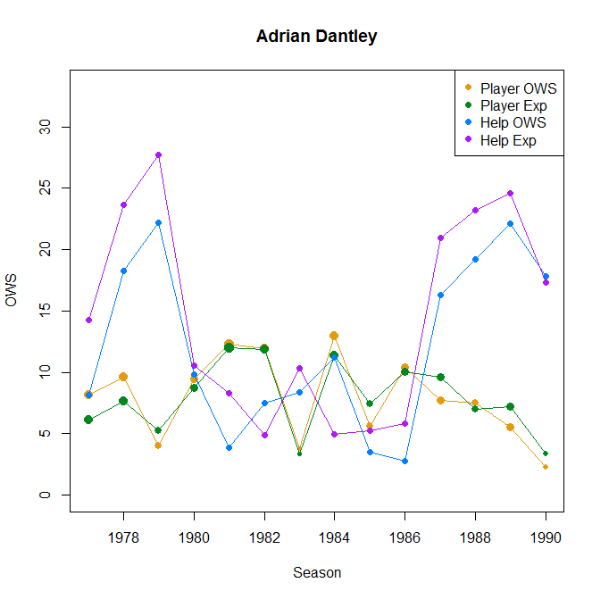
Monster scorer whose box-based metrics merit his inclusion a long time ago; the lag on his apparent impact and general lack of team success has held him back, but he nonetheless feels [easily, imo] like a top 80 inclusion at least.
He's an interesting comparison to Cliff Hagan......
Hagan's claim is as an efficient scorer. Yet he's less efficient (even relative to a less efficient league) than Dantley......and on smaller volume.......and in a weaker overall league.......and for a shorter period of time. And he has a coach who publicly criticized his defense.
So why then should I favour him over Dantley?
Oh right: ringz.
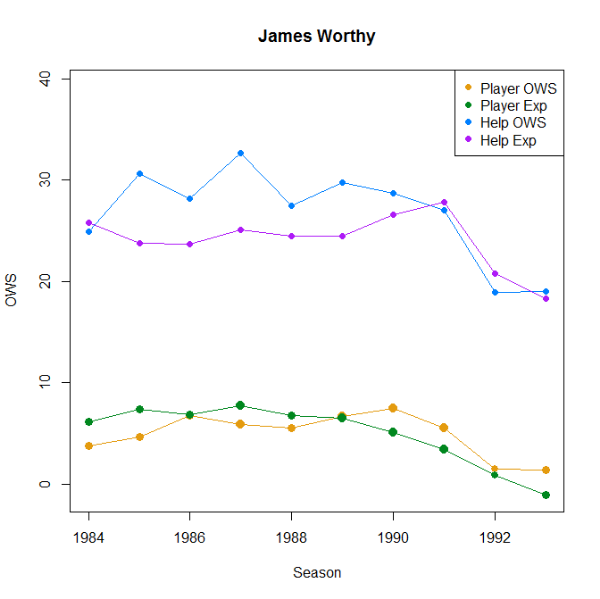
Basically, he's a short prime in a weak era, nice box-based metrics for a handful of years [with precisely two years where he looks like a playoff riser], though with impact signals that lag well-behind (and an account from a coach expounding on how he's a bad defender......which perhaps explains the phenomenon??). And I note that NO ONE in his own time thought as highly of him as we're trying to elevate him to now, after the fact.
So he still feels like a pretty weak candidate, especially with a similar [but better] player sitting right there on the same ballot.
Rudy Gobert is one of my favorite players of all-time; but he suffers in my methodology for some of the same reasons Bobby Jones did: he's got just 10 seasons [missing a significant chunk in two of them], and averaged just 30.3 mpg within this span. Granted playing time skews lower these days, but it still rides right on the edge of "limited" at times. He's actually played <21k minutes prior to this season (even Bobby Jones had almost 5k more than that). That puts too much of a cap on his possible career value to this stage. Hagan is probably the ONLY one of the candidates I'd put Gobert ahead of presently.
And again: this is perhaps my favourite player of the league currently.
Rodman gets a lot of compliments that run along the lines of "GOAT-level rebounding and all-time tier defense". Except he was rarely [ever?] both of these things at the same time. He actively sacrificed good defense to be a GOAT-level rebounder. He can be seen neglecting to box guys out to instead "chase" the rebound (to his credit, his instincts were good, as was his quickness [especially on that second/third jump], and his energy in this endeavour was tenacious). He also completely gave up perimeter defense (one of the things he was known to be a versatile "stopper" with during early years in Detroit) to chase those rebounds. This is a big part of why Robert Horry goes off like an All-Star in the series against San Antonio: because Rodman is often no where to be found near his man.
His off-court antics and persona also leave a lot to be desired.
That said, his impact signals are at least decent/good, generally, and he was a key piece in a number of title teams. Still, I think his position in lists such as this overstate his value/importance.
"The fact that a proposition is absurd has never hindered those who wish to believe it." -Edward Rutherfurd
"Those who can make you believe absurdities, can make you commit atrocities." - Voltaire

 I think he was a pretty impactful player for 11 seasons.
 These can be seen on his career PIPM graph.